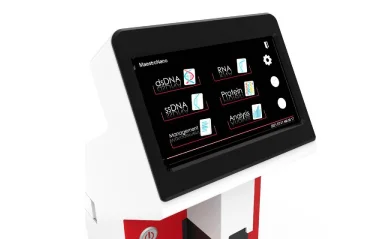
NanoDrop is one of the most accurate and fastest tools for measuring the concentration and purity of nucleic acids in molecular biology laboratories, developed by Thermo Fisher Scientific and today has become a global standard in research, diagnostic and educational laboratories. Using microvolume spectrophotometric technology, this device measures the concentration of DNA, RNA or protein in less than a few seconds with only 1 to 2 microliters of sample; without the need for cuvettes or complex dilutions.
Unlike traditional spectrophotometers that require large sample volumes and time-consuming preparation, NanoDrop creates a shorter light path by creating a very small liquid column between two optical surfaces, which allows even very concentrated samples to be measured without dilution. This feature not only saves time, but also minimizes the consumption of valuable laboratory samples.
In this article, you will learn about the following in a comprehensive and practical way:
Scientific principles of light absorption at wavelengths of 260 and 280 nm
How to calculate DNA and RNA concentration based on Beer-Lambert’s law
Correct way to work with the device and calibration steps (Blank)
Interpreting purity ratios such as A260/A280 and A260/A230
Detection of common contaminants (protein, phenol, salts and buffers)
Pro tips for increasing accuracy and reducing measurement errors
You will also learn how to check the quality of extracted samples before performing sensitive experiments such as PCR, Real-Time PCR, Sequencing, Gene Cloning, and cDNA Synthesis, because even a small amount of contamination or concentration error can affect the result of the entire experiment.
One of the important advantages of NanoDrop is the immediate display of the absorption spectrum. By viewing the spectral diagram, it is possible to detect the presence of impurities and ensure that the sample is truly pure. This capability helps researchers ensure the quality of the sample before entering the costly testing stages and avoid unnecessary repetitions.
If you work in the fields of genetics, biotechnology, microbiology, molecular medicine, or academic research, mastering NanoDrop is an essential skill. This guide will help you make faster, more accurate, and more reliable measurements and achieve more professional laboratory results.